| Element | |
|---|---|
99EsEinsteinium252.08292
8 18 32 29 8 2 |
|
| Basic properties | |
|---|---|
| Atomic number | 99 |
| Atomic weight | 252.0829 amu |
| Element family | Actinoids |
| Period | 7 |
| Group | 2 |
| Block | s-block |
| Discovery year | 1952 |
| Isotope distribution |
|---|
| None |
| Physical properties | |
|---|---|
| Density | 13.5 g/cm3 (STP) |
Atomic hydrogen (H) 8.988E-5 Meitnerium (Mt) 28 | |
| Melting | 860 °C |
Helium (He) -272.2 Carbon (C) 3675 | |
| Boiling | 996 °C |
Helium (He) -268.9 Tungsten (W) 5927 | |
| Chemical properties | |
|---|---|
| Oxidation states (less common) | +3 (+2, +4) |
| First ionization potential | 6.415 eV |
Cesium (Cs) 3.894 Helium (He) 24.587 | |
| Electron affinity | -0.300 eV |
Nobelium (No) -2.33 Atomic chlorine (Cl) 3.612725 | |
| Electronegativity | 1.3 |
Cesium (Cs) 0.79 Atomic fluorine (F) 3.98 | |
| Atomic radius | |
|---|---|
| Metallic radius | 1.86 Å |
Beryllium (Be) 1.12 Cesium (Cs) 2.65 | |
| Electronic properties | |
|---|---|
| Electrons per shell | 2, 8, 18, 32, 29, 8, 2 |
| Electronic configuration | [Rn] 5f11 |
|
Bohr atom model

| |
|
Orbital box diagram

| |
| Valence electrons | 13 |
| Lewis dot structure |
|
| Orbital Visualization | |
|---|---|
|
| |
| Electrons | - |
| Reactions |
|---|
| Es + O2 = EsO2 |
Einsteinium (Es): Periodic Table Element
Abstract
Einsteinium (Es), atomic number 99, represents the seventh transuranium element and occupies a distinctive position among the actinide series. This synthetic element was discovered in 1952 as a component of thermonuclear explosion debris and exhibits characteristic late actinide chemistry with predominant +3 oxidation states. Einsteinium's most stable isotope, ²⁵²Es, demonstrates a half-life of 471.7 days, while the more readily available ²⁵³Es isotope possesses a 20.47-day half-life. The element manifests as a silvery, paramagnetic metal with density 8.84 g/cm³ and melting point 1133 K. Extreme radioactivity produces characteristic self-luminescence and generates approximately 1000 watts per gram of thermal energy. Limited production capabilities restrict einsteinium to fundamental research applications, particularly in superheavy element synthesis investigations.
Introduction
Einsteinium occupies position 99 in the periodic table, situated within the actinide series between californium (98) and fermium (100). The element's electronic configuration [Rn] 5f¹¹ 7s² places it among the late actinides, where 5f orbital contraction significantly influences chemical and physical properties. Its discovery through thermonuclear explosion analysis established einsteinium as the first element synthesized through rapid neutron capture processes, providing crucial experimental validation for r-process nucleosynthesis mechanisms observed in stellar environments. The element's synthetic nature and extreme radioactivity have confined its study to specialized laboratories equipped for transuranium element research. Einsteinium's chemical behavior demonstrates typical late actinide characteristics, exhibiting strong similarities to its lanthanide analog holmium while maintaining distinct actinide-specific properties such as accessible divalent oxidation states.
Physical Properties and Atomic Structure
Fundamental Atomic Parameters
Einsteinium possesses atomic number 99 with electronic configuration [Rn] 5f¹¹ 7s², positioning eleven electrons within the 5f subshell. The electron distribution follows the pattern 2, 8, 18, 32, 29, 8, 2 across successive shells. Effective nuclear charge experiences significant shielding from inner f-electrons, contributing to actinide contraction effects observed throughout the series. The 5f¹¹ configuration results in one unpaired electron in the f manifold, generating paramagnetic behavior with effective magnetic moments reaching 10.4 ± 0.3 μB in Es₂O₃ and 11.4 ± 0.3 μB in EsF₃. These values represent the highest magnetic moments among actinide compounds, reflecting strong f-electron contributions to magnetic properties. Ionic radii for Es³⁺ demonstrate progressive contraction relative to earlier actinides, with coordination number dependencies typical of lanthanide and actinide series trends.
Macroscopic Physical Characteristics
Einsteinium metal exhibits silvery metallic luster with distinctive self-luminescence producing visible blue-green glow from intense radioactive decay. Density measurements yield 8.84 g/cm³, significantly lower than preceding californium (15.1 g/cm³) despite higher atomic mass. This density reduction reflects radiation-induced lattice damage and thermal expansion effects from continuous radioactive heating. Melting point occurs at 1133 K (860°C), with estimated boiling point 1269 K (996°C). The element crystallizes in face-centered cubic structure with space group Fm3̄m and lattice parameter a = 575 pm. Alternative hexagonal phases have been reported with parameters a = 398 pm and c = 650 pm, undergoing conversion to fcc structure upon heating to 573 K. Bulk modulus measurements indicate exceptional softness at 15 GPa, among the lowest values for non-alkali metals. Radiation-induced self-heating generates approximately 1000 watts per gram, causing rapid crystal lattice deterioration and contributing to the unusually low mechanical strength.
Chemical Properties and Reactivity
Electronic Structure and Bonding Behavior
Einsteinium's chemical reactivity stems from its 5f¹¹ 7s² electronic configuration, which stabilizes the +3 oxidation state through formal removal of 7s² and one 5f electron. The resulting Es³⁺ configuration [Rn] 5f¹⁰ exhibits enhanced stability through half-filled 5f manifold considerations. Divalent einsteinium, accessible particularly in solid compounds, forms through retention of one 5f electron, yielding [Rn] 5f¹¹ configuration. This oxidation state demonstrates greater stability in einsteinium compared to lighter actinides like protactinium, uranium, neptunium, and plutonium. Coordination chemistry exhibits typical actinide characteristics with coordination numbers ranging from 6 to 9, depending on ligand size and electronic requirements. Bond formation predominantly involves ionic character with minimal 5f orbital participation in covalent interactions. The element readily forms complexes with oxygen-donor ligands, halides, and organometallic chelating agents.
Electrochemical and Thermodynamic Properties
Electronegativity values follow Pauling scale designation of 1.3, consistent with metallic character and positioning within the actinide series. First ionization energy measures 619 kJ/mol, reflecting the relative ease of 7s electron removal compared to inner 5f electrons. Successive ionization energies demonstrate progressive increases characteristic of f-element chemistry. Standard reduction potentials for Es³⁺/Es couple remain incompletely characterized due to experimental limitations imposed by extreme radioactivity and limited sample availability. Thermodynamic stability of einsteinium compounds generally parallels late actinide trends, with oxides and fluorides demonstrating enhanced stability relative to other halides. Solution chemistry in aqueous media exhibits typical trivalent actinide behavior with pale pink coloration in acidic solutions.
Chemical Compounds and Complex Formation
Binary and Ternary Compounds
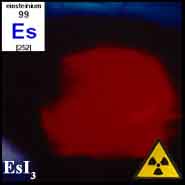
Einsteinium sesquioxide (Es₂O₃) represents the most thoroughly characterized binary compound, obtained through thermal decomposition of einsteinium nitrate. The oxide crystallizes in multiple polymorphs including cubic (Ia3̄ space group, a = 1076.6 pm), monoclinic (C2/m, a = 1411 pm, b = 359 pm, c = 880 pm), and hexagonal (P3̄m1, a = 370 pm, c = 600 pm) forms. Phase transitions occur spontaneously through self-irradiation and thermal effects. Einsteinium halides demonstrate systematic trends with EsF₃ adopting hexagonal symmetry, EsCl₃ crystallizing in orange hexagonal UCl₃-type structure with 9-fold coordination, EsBr₃ forming yellow monoclinic AlCl₃-type structure with octahedral coordination, and EsI₃ exhibiting amber hexagonal structure. Divalent halides EsCl₂, EsBr₂, and EsI₂ can be synthesized through hydrogen reduction of corresponding trihalides. Oxyhalides including EsOCl, EsOBr, and EsOI form through controlled hydrolysis reactions with mixed water-hydrogen halide vapors.
Coordination Chemistry and Organometallic Compounds
Coordination complexes of einsteinium exhibit behavior consistent with late actinide chemistry, forming stable chelates with oxygen and nitrogen donor ligands. β-diketone complexes have been synthesized for luminescence studies, though radiation quenching severely limits observable emission. Einsteinium citrate complexes demonstrate potential for radiopharmaceutical applications, though practical implementation remains limited by availability and extreme radioactivity. The Es³⁺ ion shows preference for hard donor atoms, following Irving-Williams series trends adapted for actinide chemistry. Coordination geometries typically range from 6 to 9, with higher coordination numbers favored by larger ligands. Organometallic chemistry remains largely unexplored due to sample limitations and radiation-induced decomposition of organic ligands.
Natural Occurrence and Isotopic Analysis
Geochemical Distribution and Abundance
Einsteinium demonstrates no natural terrestrial occurrence due to the absence of stable isotopes and insufficient half-lives for geological persistence. Crustal abundance essentially equals zero, with only synthetic production providing measurable quantities. The element would theoretically form through multiple neutron capture processes in natural uranium ores, but probability calculations indicate negligible formation rates under normal geological conditions. Primordial einsteinium potentially present during Earth's formation has completely decayed through radioactive processes. The natural nuclear reactor at Oklo, Gabon, may have produced trace einsteinium quantities approximately 1.7 billion years ago, but any such material has since undergone complete radioactive decay to stable daughters.
Nuclear Properties and Isotopic Composition
Eighteen isotopes and four nuclear isomers comprise the known einsteinium isotopic inventory, spanning mass numbers 240-257. All isotopes exhibit radioactive instability with no stable nuclear configurations. The longest-lived isotope, ²⁵²Es, possesses half-life 471.7 days through alpha decay (6.74 MeV) to ²⁴⁸Bk and electron capture to ²⁵²Cf. Einsteinium-253, the most extensively studied isotope due to reactor production accessibility, undergoes alpha decay (6.6 MeV) with 20.47-day half-life to ²⁴⁹Bk, alongside minor spontaneous fission branching. Other significant isotopes include ²⁵⁴Es (275.7 days, α/β decay modes) and ²⁵⁵Es (39.8 days, predominantly β decay). Nuclear isomer ²⁵⁴ᵐEs demonstrates 39.3-hour half-life. Critical mass calculations indicate 9.89 kg for bare ²⁵⁴Es spheres, reducible to 2.26 kg with appropriate neutron reflection, though these quantities vastly exceed total global production.
Industrial Production and Technological Applications
Extraction and Purification Methodologies
Einsteinium production relies exclusively on artificial synthesis through high-flux neutron irradiation in specialized reactors. Primary facilities include the 85-megawatt High Flux Isotope Reactor (HFIR) at Oak Ridge National Laboratory and the SM-2 reactor at Russia's Research Institute of Atomic Reactors. Production begins with californium-252 targets undergoing neutron capture: ²⁵²Cf(n,γ)²⁵³Cf → ²⁵³Es through 17.81-day beta decay. Typical campaigns process tens of grams of curium to yield milligram quantities of einsteinium alongside decigram californium and picogram fermium amounts. Separation procedures involve multiple stages of cation-exchange chromatography at elevated temperatures using citric acid-ammonium buffer systems at pH 3.5. Ion-exchange columns with α-hydroxyisobutyrate eluants enable identification based on elution timing. Alternative solvent extraction methods employ bis-(2-ethylhexyl) phosphoric acid for berkelium separation, crucial due to ²⁵³Es decay contamination. Purification efficiency typically reduces initial yields tenfold, with final products containing isotopically pure einsteinium suitable for research applications.
Technological Applications and Future Prospects
Current applications remain confined to fundamental nuclear physics research, particularly superheavy element synthesis investigations. Einsteinium-254 serves as target material for superheavy element production attempts due to favorable nuclear properties including 275.7-day half-life and sufficient cross-sections for fusion reactions. The 1955 synthesis of mendelevium through Es-253(α,n)Md-256 reaction demonstrated einsteinium's utility in extending the periodic table. NASA employed ²⁵⁴Es as calibration standard in Surveyor 5 lunar chemical analysis due to favorable mass characteristics reducing spectral interference. Potential radiopharmaceutical applications remain theoretical due to production limitations and extreme radioactivity presenting insurmountable safety challenges. Future technological prospects depend critically on improved production methods, though fundamental nuclear properties impose inherent limitations on einsteinium availability.
Historical Development and Discovery
Einsteinium discovery emerged from systematic analysis of debris from the Ivy Mike thermonuclear test conducted November 1, 1952, at Enewetak Atoll. Albert Ghiorso's team at Lawrence Berkeley National Laboratory, collaborating with Argonne and Los Alamos facilities, identified element 99 through characteristic 6.6 MeV alpha decay signatures. Initial separation required processing filter papers from aircraft flown through explosion clouds, recovering fewer than 200 atoms for identification. The discovery mechanism involved uranium-238 absorption of 15 neutrons during the microsecond-duration neutron flux (10²⁹ neutrons/cm²·s), followed by seven beta decays: ²³⁸U + 15n → ²⁵³Cf → ²⁵³Es. Simultaneous identification of fermium through similar processes validated multiple neutron capture theories essential for understanding stellar nucleosynthesis. Military classification delayed publication until 1955, when results were presented at the Geneva Atomic Conference. The naming honored Albert Einstein, reflecting the element's connection to nuclear physics principles. Subsequent laboratory synthesis through cyclotron bombardment and reactor irradiation established routine production methods, though quantities remained microscopic. Competition with Swedish researchers at the Nobel Institute for Physics highlighted international interest in transuranium element discovery during the 1950s nuclear research expansion.
Conclusion
Einsteinium occupies a unique position as the heaviest element observable in macroscopic quantities, representing the practical limit for bulk transuranium element studies. Its 5f¹¹ electronic configuration exemplifies late actinide chemistry while demonstrating the highest magnetic moments among actinide compounds. The element's discovery through thermonuclear explosion analysis provided fundamental insights into rapid neutron capture processes essential for understanding stellar nucleosynthesis. Current research focuses on superheavy element synthesis applications and fundamental nuclear physics investigations. Future developments in production technology may expand research capabilities, though nuclear stability constraints impose fundamental limitations on einsteinium's practical applications beyond basic scientific inquiry.

Please let us know how we can improve this web app.